

Quick Answer
What is the difference between Chemex and drip coffee? Which one will win the Chemex vs drip coffee comparison? Which produces the perfect cup? Which is easier to use and clean — and which demands more skill and attention?
If you’re in a hurry, here’s the short version:
A Chemex uses a pour-over brewing technique to create clarified coffee, while an electric drip coffee maker uses automated pouring to brew coffee faster and with less effort. Chemex produces better-quality, more complex coffee but requires more skill. For a straightforward cup with minimal fuss, a drip machine is the smart choice.
Choose Chemex if you enjoy the ritual of brewing and want the best possible flavor. Choose a drip machine if you want consistent, low-effort coffee — especially for multiple cups at once.
Chemex and drip coffee actually rely on the same underlying method — pour-over. They may look similar on the surface, but the skills required, and the coffee they produce, are significantly different. Asking whether they’re basically the same is a bit like asking whether French Press and AeroPress are similar just because both use immersion — they’re related in principle, but very different in practice. Read on to see exactly why Chemex has earned such a devoted following among coffee lovers.
How Chemex and Drip Coffee Makers Work
The Chemex
The Chemex is a manual pour-over coffee maker invented in 1941. It’s an hourglass-shaped glass flask with a conical funnel neck, using thick, proprietary paper filters — noticeably thicker than the ones in most drip machines.
How it works: Coffee grounds go into the thick filter, and water is poured over the top and allowed to drip through. This results in a clean-tasting cup: the thick filter eliminates most of the coffee oils, extracting better flavor while filtering out bitter undertones.

The Drip Coffee Maker
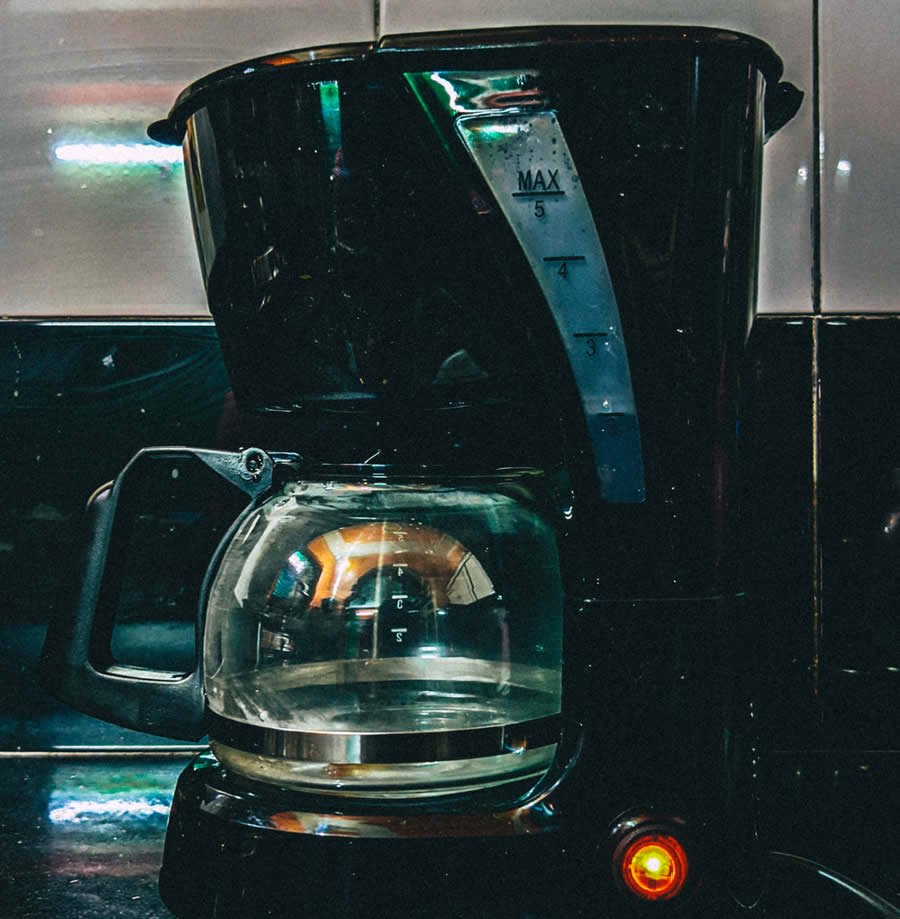
Drip coffee makers were built to automate what’s essentially pour-over coffee. While manual pour-over methods like Chemex require you to precisely and carefully pour water over the grounds yourself, drip machines handle nearly all of it for you.
In other words: Chemex demands skill, patience, and time. Drip coffee is straightforward, and the machine does the work.
How it works: Water heats in a tank before being released gradually over coffee grounds in a brew basket or filter, dripping filtered coffee into the carafe below. Like the Chemex, it’s still a filter-drip method — the difference is automation. Water goes in, heats automatically, pours over the grounds, and drips through the filter paper without you lifting a kettle. With built-in grinders, a water reservoir, and a timer, even affordable machines automate practically the entire process — though unless you’re using a high-end model, you won’t be able to adjust water temperature or distribution the way you can with a Chemex.
The 5 Key Differences
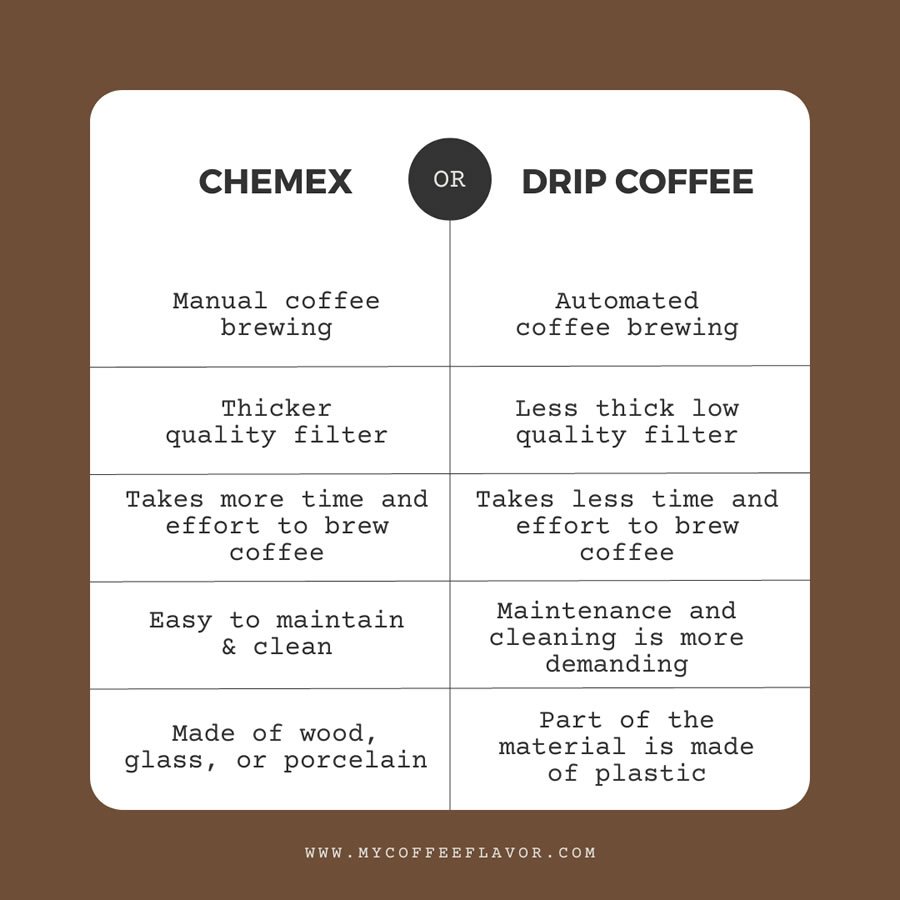
| Criteria | Chemex | Drip Coffee |
|---|---|---|
| Brewing | Manual | Automated |
| Filter | Thick, premium paper | Thinner, standard paper |
| Control | Full control over pour, temp, timing | Little to none (unless high-end model) |
| Brewing method | Pour-over | Pour-over (automated) |
| Convenience | Slower, more hands-on | Fast, minimal effort |
| Cleaning | Easy — glass/porcelain, rinse and go | More demanding — multiple parts, plastic components |
| Aesthetic | Iconic 1940s design, display-worthy | Functional, ordinary |
1. Filter Thickness
The Chemex’s thicker filter removes more oils and fine grounds, producing a cleaner, brighter cup with fewer bitter notes. Standard drip filters let more oils through, giving a heavier, sometimes muddier flavor profile.
2. Brewing Method
With Chemex, everything is done manually. You carefully pour water from a kettle over freshly ground coffee to create an even brew — often in stages: a little water first to let the grounds bloom, then the remaining water poured gradually. A quality kettle lets you control water temperature and saturation, and pour-over coffee, while it takes longer and requires extra steps, extracts a more intricate flavor as a result.
With a drip machine, everything is automated. Because even affordable machines handle nearly the entire process, drip coffee makers win clearly on convenience — no additional steps or waiting, just a quick cup thanks to the built-in grinder, water reservoir, and timer. The tradeoff: you won’t be able to modify temperature or water distribution unless you’re using a high-end model.
3. Convenience
If you’re concerned with convenience, you’ll be tempted to reach for a drip machine — but that means opting for convenience over quality. You’ll save time and effort, but lose some of the intricate flavor a manual pour-over offers.
Making coffee with a drip machine takes about two minutes: the machine simply drips water over a bed of coffee without allowing enough time to fully extract the flavors, and the result, while quick, lacks some of that depth.
Manual pour-over makers like Chemex take longer — but because you control how long to brew, you can soak the grounds evenly and let the flavors develop before adding the rest of the water. That extra control is exactly what produces a far better extraction.
4. Cleaning and Material
Maintenance and cleaning is the biggest drawback of drip coffee makers — these devices are difficult to keep truly clean unless you do it after every single brew.
A manual pour-over like Chemex is far less complicated to clean. As opposed to most in-home drip machines I’ve used — which contain a lot of plastic that seems to absorb some of the tastes and aromas of each roast — Chemex is made of glass or porcelain, so no flavors or aromas linger in the brewing process.
5. Aesthetics
The Chemex’s hourglass shape and wood collar have made it a design-world favorite since the 1940s — many owners keep it on the counter as a display piece. Drip machines are built for function, not form.
Chemex vs Drip Coffee: Price Comparison
- Chemex starter setup: Roughly $40–$50 for the classic glass Chemex, plus $10–$15 for a pack of filters (which typically last months of daily brewing).
- Drip coffee maker: Entry-level models start around $20–$30; higher-end machines with built-in grinders or temperature control can run $100–$200+.
For occasional or single-cup brewing, Chemex is the cheaper long-term option. For brewing multiple cups daily with minimal effort, a mid-range drip machine often works out more practical.
Our Verdict: Which Should You Buy?
If you’re brewing for yourself, enjoy the process, and want the best flavor a filter method can offer, get a Chemex. It rewards a little patience with a genuinely better cup.
If you’re brewing for a household, want consistency without thinking about it, or need multiple cups quickly in the morning, a drip machine is the more practical choice — you’ll trade some flavor complexity for real convenience.
Either way, you’re not making a bad choice — just a different one, depending on what you value more: ritual and flavor, or speed and ease.
FAQ
Is Chemex a pour-over?
Yes — Chemex is a manual pour-over brewer. It uses the same core principle as other pour-over methods, but with its own thicker filter and distinctive glass design.
Does Chemex make good coffee?
Yes, generally regarded as one of the cleanest, most flavorful manual brewing methods, thanks to its thick filter and full manual control over the pour.
Is a drip coffee maker the same as a Chemex?
Not exactly — both use a filter-drip method, but a Chemex is fully manual while a drip machine automates the process. A Chemex needs more attention and produces a different flavor profile from most drip machines.
How is a Clever Dripper different from a Chemex?
A Clever Dripper combines immersion brewing (like a French press) with drip filtration, using a valve to release the coffee once brewed. A Chemex is a continuous pour-over with no immersion step — the two produce noticeably different flavor profiles.
Final Thoughts
The real difference between Chemex and drip coffee comes down to control and effort. Chemex’s thick filter and fully manual process reward you with a cleaner, more complex cup — if you’re willing to slow down. Drip machines trade some of that flavor depth for genuine convenience.
If you’re curious how these methods stack up against other brewing styles, see our comparisons of French Press vs AeroPress and French Press vs Pour Over, or browse our full breakdown of coffee types explained.
For more on Chemex’s history and official brewing guides, see Chemex Coffeemaker’s official site.
About the Author
Written by RHALMI Mohammed — ten years of hands-on coffee obsession, testing brewing methods, comparing gear, and chasing the perfect cup at home. Every recipe, comparison, and guide on My Coffee Flavor comes from actual brewing, not just research.